
How restorative dentistry evolved: fillings to crowns
If you have been visiting the dentist for a few decades, you have lived through a quiet revolution in how teeth are repaired. The materials, techniques and thinking have all moved on — and for patients, that means more choice than ever. Here is a plain-English tour of how restorative dentistry has evolved, and why we still keep a full range of options on the table.
Where it started: traditional fillings
For most of the twentieth century, the workhorse of dentistry was the silver amalgam filling. Amalgam is strong and hard-wearing, and many people still have these fillings doing their job perfectly well today. An older amalgam filling does not need to be replaced simply because of its age — if it is sound and the tooth around it is healthy, leaving it alone is often the right call. It is a different story once cracks start radiating out from an old filling, as our real case of repairing a cracked tooth behind an old filling shows.
The trade-offs are familiar: amalgam is silver-grey rather than tooth-coloured, and placing it sometimes meant removing more tooth than was strictly necessary to hold it in place.
The shift to tooth-coloured composites
Modern tooth-coloured composite fillings changed that. Composite resin bonds directly to the tooth and is matched to the shade of your natural teeth, so the repair blends in. Because it bonds rather than relying purely on shape for grip, it can often be placed more conservatively — preserving more of your healthy tooth.
A stronger build: BioClear
The next step forward was less about a new material and more about a better technique. BioClear is a methodology for building up composite resin that provides greater structural integrity — better adaptation, smoother surfaces and a stronger end result. One of its real advantages is that a BioClear filling can sometimes provide enough support to strengthen a cracked or heavily filled tooth without the need for a crown. Our team has additional training in this technique, and it is often the conservative option we consider before recommending a crown.
Protecting the whole tooth: biomimetic crowns
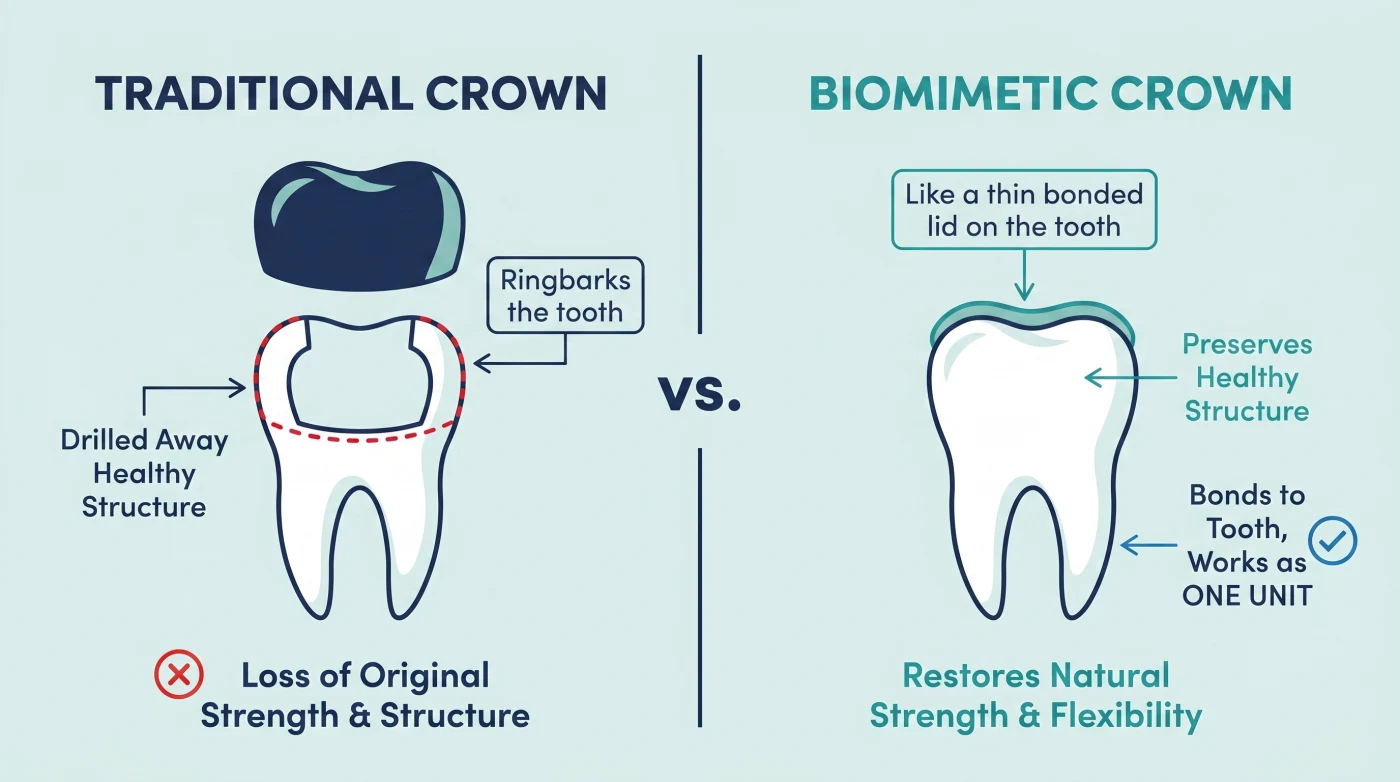
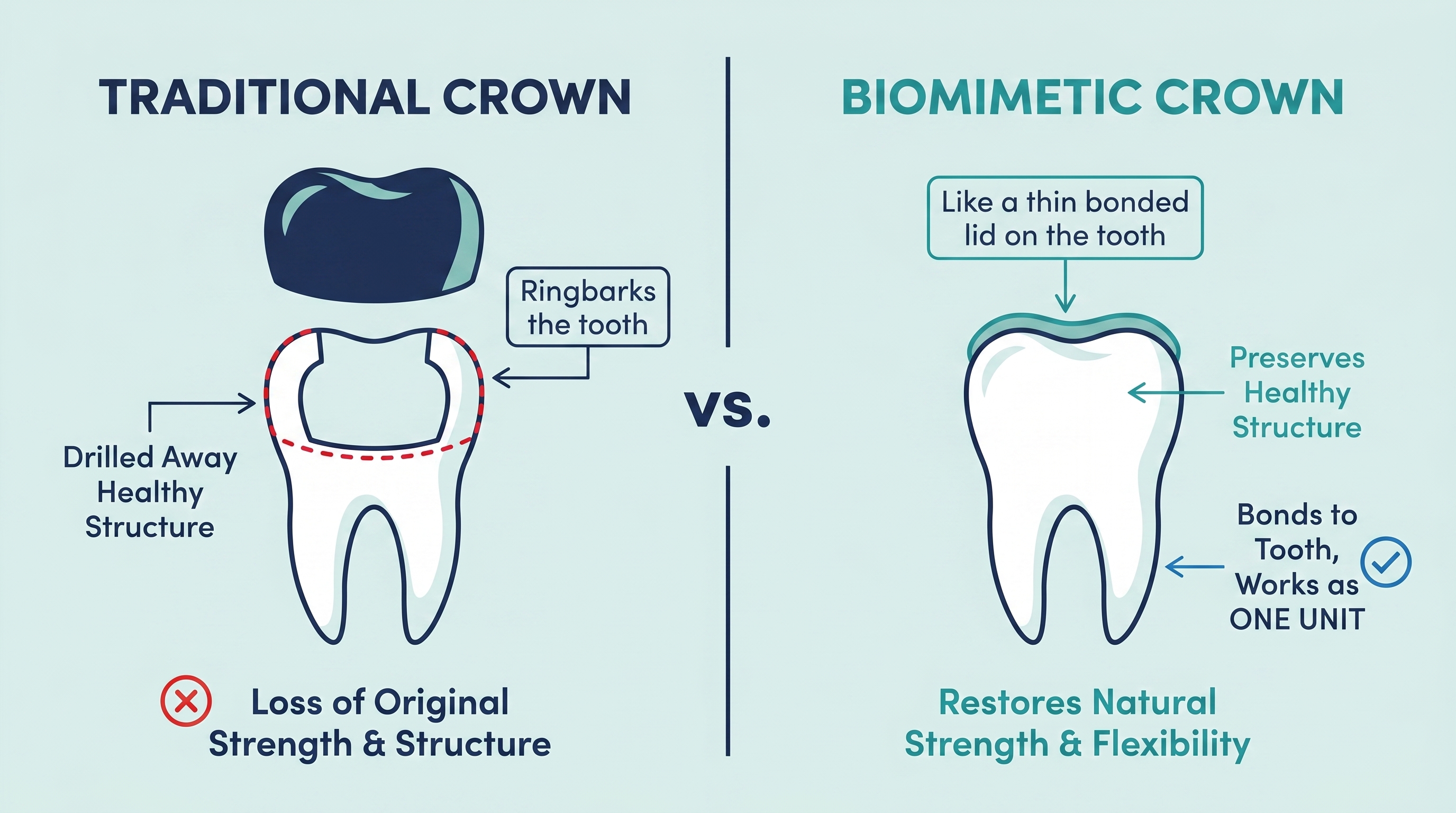
When a tooth needs more than a filling can offer, the modern answer is a biomimetic crown (bio-crown). Where a traditional crown caps a tooth by reducing it significantly, a biomimetic crown bonds to the remaining tooth and works with it as a single unit — recreating the strength the tooth had before it was ever filled, while conserving as much natural structure as possible. You can read more in our companion article, what is a biomimetic crown?
Newer isn't always necessary — options to suit every patient
Here is the part we think matters most: the latest technique is not automatically the right one for every tooth or every person. A small, simple cavity may be perfectly served by a straightforward composite filling. Sometimes a sound older filling is best left alone. Other situations genuinely call for BioClear or a biomimetic crown to protect the tooth properly.
That is why we keep the full range of restorative options available, and why we take the time to explain the choices — weighing how much healthy tooth can be preserved, how long each option is likely to last, and what suits your priorities and budget. Our job is to recommend the most conservative treatment that genuinely looks after your tooth, then help you make an informed decision.
Let's find the right option for your tooth
If you are weighing up a filling, a repair or a crown and want to understand the options, we are happy to talk it through. Call us on (07) 3281 6666 or book an appointment online, and we will help you choose the approach that is right for you. For a step-by-step look at how we tell which one a particular tooth needs, read our guide to crown or filling: which does your tooth need.
Here is the take-home guide we give patients after this kind of visit, ready to print or save:

Recent articles



Why do crowns fail, and how long do they last?
24 Sept 2026