
Catching dental problems early: a patient's story
This is a real patient story, shared anonymously with the patient's blessing. We think it says something a lot of people will recognise — that you can be living with a dental problem for years and not even realise it. Here it is in his own words, followed by Dr Andrew's perspective on why we treat these things early.
In the patient's words
Like a lot of people, I let things slide. We were a young family, we'd moved interstate, and life was busy. Before I knew it, five or six years had gone by since I'd last seen a dentist.
I'd known Dr Andrew for a long time, so when we moved back to Brisbane I sought him out — partly because I had some pain in one of my back teeth. It was only a minor discomfort, but somehow I knew there was a bigger issue sitting underneath it.
We went through the usual check-up and clean, and Dr Andrew picked up a crack in my back molar — exactly the tooth that had been bothering me. But he also found something I had no idea about: enamel wear and some wear on the root surface on the upper right side of my mouth. I genuinely hadn't noticed it. Or rather, I'd become so accustomed to it that I'd stopped thinking of it as a problem at all.
Because I'd known and trusted Dr Andrew for years, I took his advice and we went ahead and repaired both — the cracked molar and the worn area on the top right.
Here's the part that stuck with me. Talking to Dr Andrew afterwards, the repair on that top right side has been honestly amazing. I hadn't realised how much low-level discomfort I'd been carrying around. I'd just become accustomed to it — it had been there so long that it had become normal.
That conversation is the reason this article exists. If other patients are anything like me, they could be living with discomfort they don't even recognise, simply because it's been there so long. I really appreciated Dr Andrew's straightforward approach — he told me what he saw, explained why it mattered, and let me make the call.
Dr Andrew's perspective: why we treat these things early
Stories like this one are more common than you might think, and they get to the heart of how we approach dentistry. Our job is to help you keep your own teeth for a lifetime. Natural teeth are worth preserving, and almost everything we do is aimed at protecting the teeth you already have rather than replacing them.
The thing this patient describes — becoming desensitised to a problem — happens to a lot of people. Wear and small cracks tend to come on gradually, over years. Because the change is so slow, the body quietly adjusts and you stop noticing. But while you've adjusted to it, the wear or the crack is still doing real damage underneath. By the time it finally announces itself, the simple fix has often become a bigger one.
Think of a crack in a windscreen
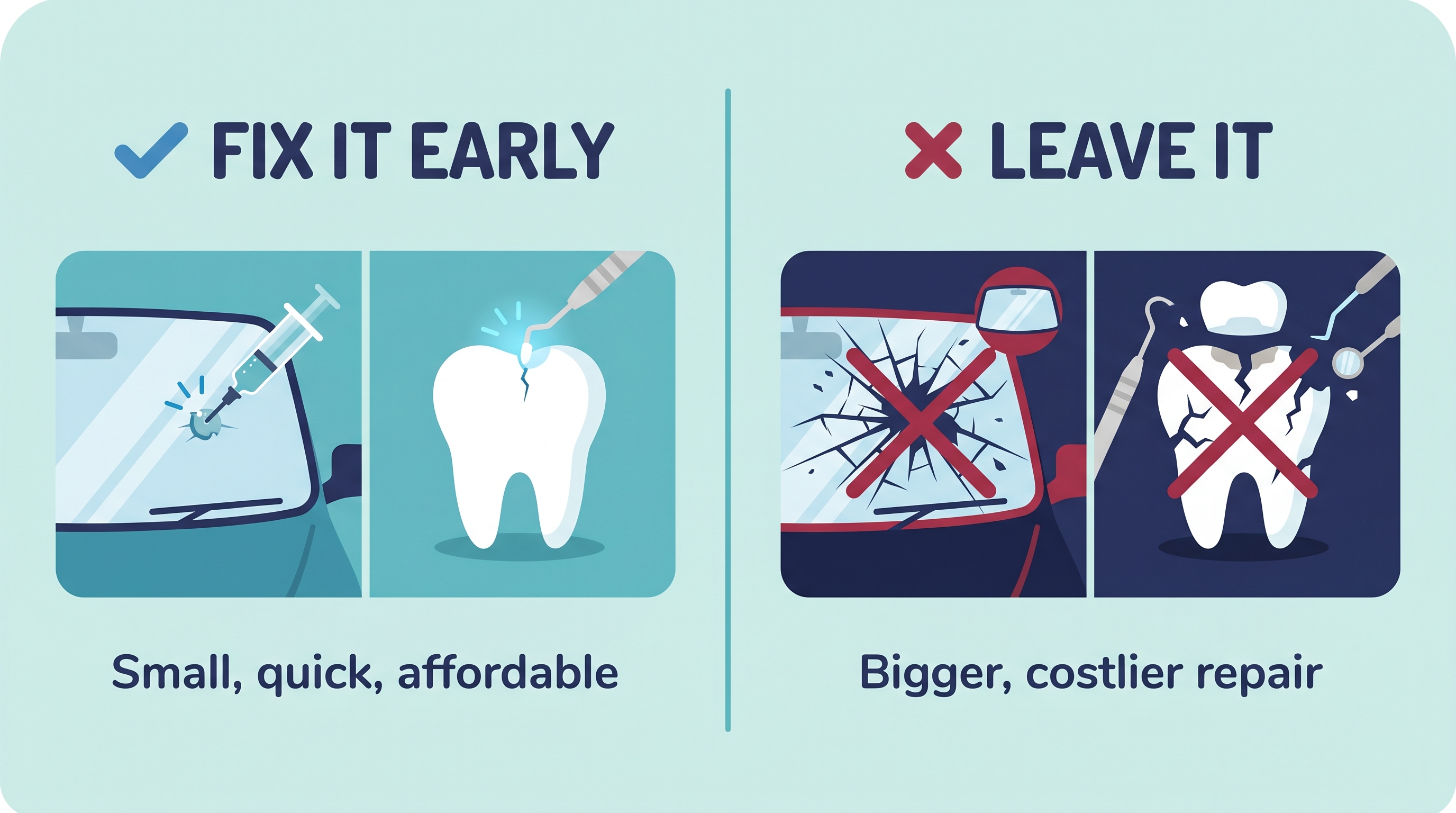
I often use the windscreen analogy with patients. When a stone chips your windscreen, a small early repair is quick and inexpensive. Leave it, and the crack spreads until the whole windscreen has to be replaced. Teeth behave in much the same way. A little bit of work up front — sealing a crack, restoring some worn structure — prevents a great deal of work, cost and discomfort down the track.
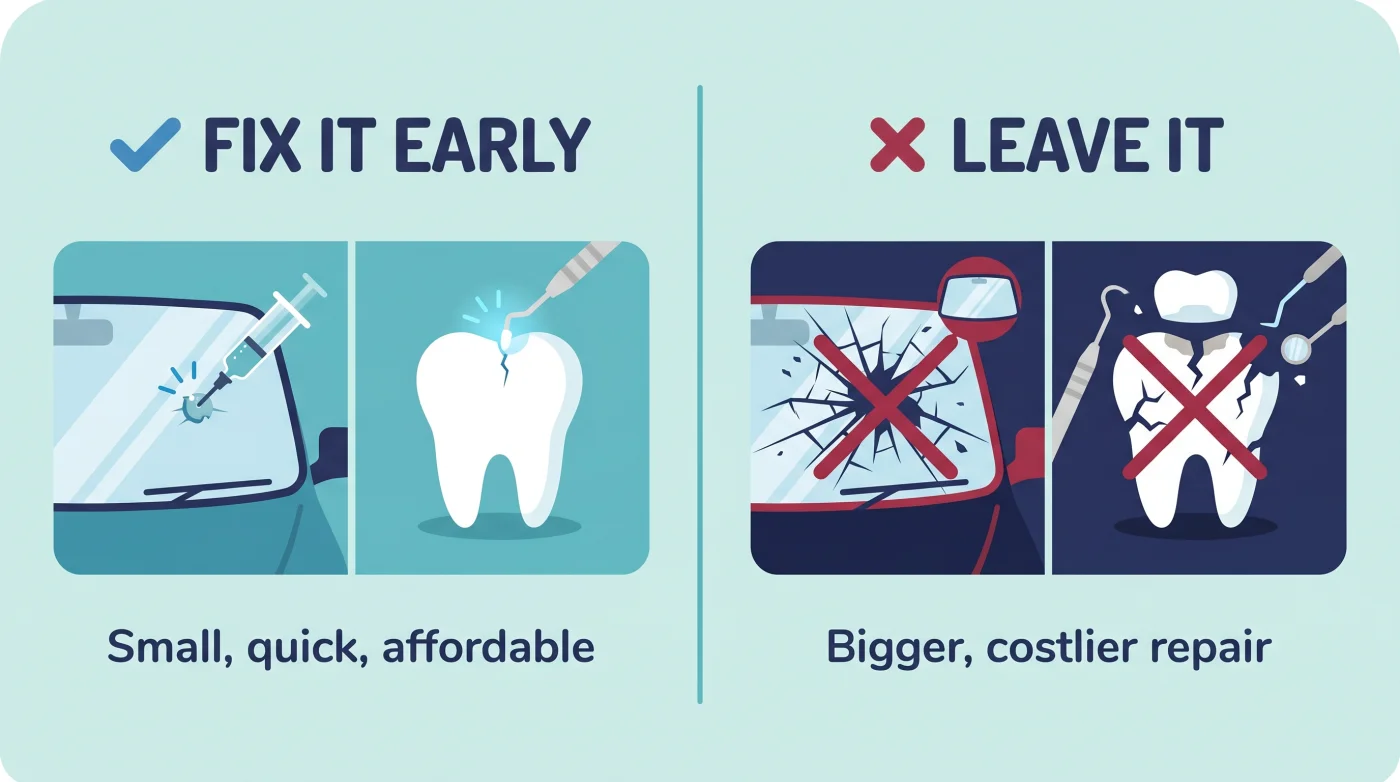
That's really what we mean when we say prevention beats repair. It isn't a slogan; in dentistry it's simply true that looking after a small problem now almost always beats rebuilding a bigger one later. And the earlier we act, the more of your natural tooth we can keep — which is exactly what our conservative, tooth-preserving approach is built around.
What this means for you
If you've had a few busy years away from the dentist, there's no judgment here. Life happens, and this patient's story shows how easily it does. The point is simply this: discomfort you've "gotten used to" is worth mentioning. So are teeth that look a little shorter or more worn than they used to, a twinge when you bite, or sensitivity near the gumline. These are often the early signs of the very things you stop noticing. A thorough examination is how we bring them to light, as this companion story on catching tooth decay early with magnification shows, even when someone has kept up their regular check-ups.
In this patient's case, the worn area was restored with conservative, tooth-coloured restorative dentistry, and the cracked molar was protected before the crack could spread further. Both were straightforward precisely because we caught them in time.
Here is the take-home guide we give patients after this kind of visit, ready to print or save:

Talk to us
If something in this story sounds familiar — a bit of discomfort you've learned to live with, or simply a long gap since your last visit — we'd be glad to take a look. Call us on (07) 3281 6666 or book an appointment online, and we'll give you a straightforward assessment and talk through the most conservative way to look after your teeth.
Recent articles



Why do crowns fail, and how long do they last?
24 Sept 2026